For the depressed scars left behind where acne has cleared, improvement can be expected from dot peeling, in which high-concentration TCA (trichloroacetic acid) is applied locally to the scarred area only. It is one form of the CROSS technique, which encourages regeneration by dabbing the agent onto the base of the scar like a dot, and it is used mainly for narrow, deeply depressed scars.
This column summarises how dot peeling works, which scars it suits, and the key points of consultation and aftercare.
How does dot peeling fill in a scar?
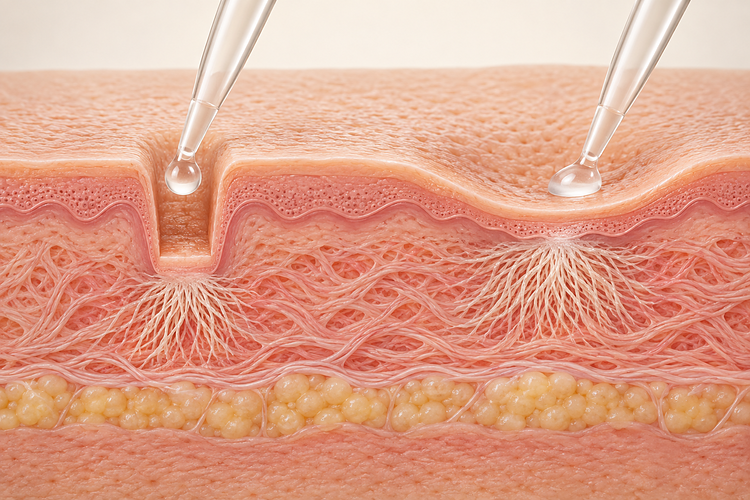
Dot peeling is formally called the CROSS technique, and it is carried out by applying a high-concentration TCA solution directly and only to the spot where the scar is depressed, stimulating the tissue there. Because the agent is dabbed onto the base of the scar alone, sufficient stimulation can be delivered while damage to normal skin stays small.
Skin touched by a high-concentration acid undergoes temporary injury as its proteins are denatured, and in this process fibroblasts are activated and produce new collagen and elastin. The more times this process is repeated, the more the edges of the scar can be expected to soften and the skin texture to become smoother along with them.
- Protein denaturation — high-concentration TCA temporarily denatures the proteins in the scarred area
- Fibroblast activation — the cells that make collagen are woken up as the injury heals
- Tissue regeneration — new collagen and elastin build up and the edges of the scar soften
Which scars is dot peeling suited to?
Acne scars are divided into narrow, deeply depressed ice-pick scars, rounded hollow scars, and large, irregular forms. Dot peeling is mainly used for scars with clear edges and a narrow depression, because the agent can be delivered accurately to the base and the stimulation can reach the dermis evenly.
Scar tissue that is already depressed does not fill in by itself, and the longer it is left, the firmer the adhesions become, so recovery tends to be slower even when care is started later. The more clearly depressed the form, as with boxcar or rolling scars and sunken surgical marks, the more it helps to begin care early.
- Boxcar scars — clearly edged, narrow and deeply depressed, they are the main target of dot peeling
- Rolling scars — fibrous tissue pulls the skin down into a wave-like depression, so texture needs improving across a wider area
- Sunken surgical scars — the agent is dabbed onto the locally deep depression to encourage regeneration
- Enlarged pores — the same principle is applied around pores that have lost firmness and widened
Why does the consultation before the procedure matter?
Every scar differs in its cause, depth and shape, in whether pigmentation is present, and in the firmness and sensitivity of the skin, so the same concentration of TCA cannot be applied to all of them in the same way. Some scars are suited to dot peeling while others respond better to a different method, and this is why a consultation is needed.
The pressure and depth with which the agent is delivered to the base of the scar also directly affect the outcome, so even with the same agent the result can vary with the practitioner's level of skill. If the concentration is not right, it can lead to side effects such as redness, inflammation or pigmentation.
How should the skin be cared for after the procedure?
The new skin that comes up after the wound has closed is fragile and sensitive, and when it is exposed to ultraviolet light, melanin production is stimulated and the scarred area easily darkens to black or brown. During the 1 to 2 weeks of aftercare, it is advisable to use a gentle cleanser and to press the skin dry with a dry towel rather than rubbing.
When the skin becomes dry, its barrier function weakens and scars can stand out more, and when moisture is lacking, collagen is not produced smoothly and the scar can form with a rough surface, so a healing ointment should be applied consistently. Flakes and scabs are better left to come away without being picked off.