Yonsei Kim & Lee Dermatology Doctor's Column
Dermatology Column

Is Increased Hair Shedding an Early Sign of Hair Loss?

The causes and types of hair loss, its early signs, and how diagnosis and treatment proceed.

Published 2026-10-16 Updated 2026-10-16 Reviewed by Taehyung Kim, Medical Director · Dermatology Specialist

If more hair than usual is falling out and the forehead and crown lines look different, the start of hair loss can be suspected. Hair loss appears not from genetics alone but from several overlapping factors such as hormonal changes, stress and scalp condition, so the more accurately the cause and type are identified, the sooner the direction of care can be set.

This article sets out the causes and types of hair loss, its early signs, and the diagnostic and treatment process, to explain what should be checked.

01

What causes hair loss?

Key point
Hair loss arises not only from genetics but from several overlapping factors, including hormonal changes, stress and the condition of the scalp. Because the direction of care changes with the cause, it should first be checked which factors are at work in each case.

Genetic factors are cited as a typical background that raises the likelihood of hair loss when there is a family history. If parents or grandparents had hair loss, keeping in mind that a similar pattern may follow and making a habit of checking the scalp condition in advance is as important as dealing with other causes.

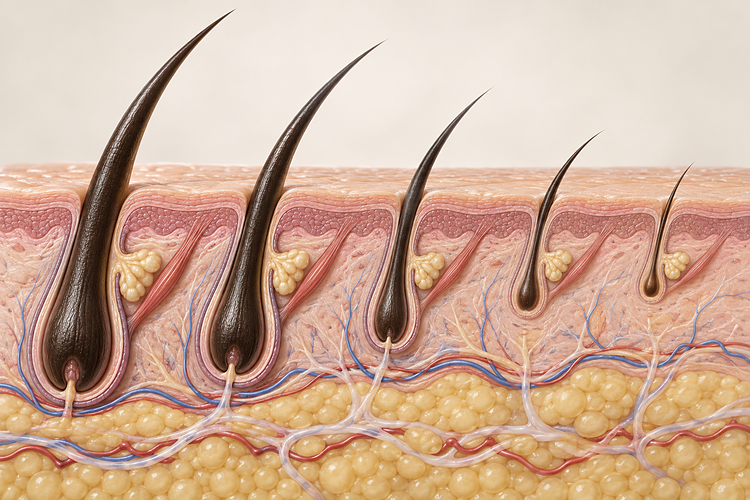
When a male hormone called dihydrotestosterone increases excessively, hair follicles shrink, hair becomes thinner and the growth cycle shortens. When chronic stress is added, blood circulation declines and hair roots weaken, and frequent hair dyeing or scalp conditions such as seborrhoeic dermatitis also affect the symptoms.

  • Genetic factors — a family history raises the likelihood of hair loss
  • Hormonal changes — an increase in dihydrotestosterone makes hair follicles shrink
  • Stress — interferes with blood circulation and weakens hair roots
  • Scalp condition — frequent dyeing or scalp conditions such as seborrhoeic dermatitis have an effect
Anatomy illustration related to Is Increased Hair Shedding an Early Sign of Hair Loss?
02

Are there different types of hair loss?

Key point
Hair loss is divided into several types according to its pattern, including male pattern hair loss, female pattern hair loss, alopecia areata and telogen effluvium. Even within hair loss, the way it progresses and the direction of care differ, so the type should be identified first.

Male pattern hair loss progresses as the forehead line gradually widens or the hair density at the crown noticeably decreases, whereas female pattern hair loss shows a pattern in which the hairline is relatively preserved while hair density decreases overall from the central area, so the visible form itself is different.

Alopecia areata is characterised by hair falling out in round patches due to stress or immune system abnormalities; telogen effluvium appears temporarily after childbirth or excessive dieting; and seborrhoeic hair loss tends to develop gradually as ongoing scalp inflammation weakens the hair follicles.

  • Male pattern hair loss — progresses as the forehead widens or the crown starts to look thin
  • Female pattern hair loss — the hairline is preserved but overall hair density decreases
  • Alopecia areata — hair falls out in round patches due to stress or immune system abnormalities
  • Telogen and seborrhoeic hair loss — appear after childbirth or dieting, or because of scalp inflammation
03

What are the early signs of hair loss, and how do diagnosis and treatment follow?

Key point
Losing 100 or more hairs a day is regarded as an early sign. The cause is identified through a review of medical history, a scalp examination and blood tests, and treatments are then combined. Of people who have actually received treatment, 7 to 8 out of 10 report being satisfied.

If it feels as though more than 100 hairs are falling out a day, or if the forehead line is gradually widening and the crown is starting to look thin, this can be seen as an early sign of hair loss, and when it is found at this stage, the outlook that can be expected from later care is relatively more favourable.

Diagnosis begins with a review of medical history covering family history, when the symptoms started and lifestyle habits, followed by a scalp magnifier examination and a hair pull test to check the condition. If needed, blood tests checking thyroid, iron and testosterone levels are also carried out, so that the cause is narrowed down in detail.

Once the cause is identified, mesotherapy, also known as scalp injections, low-level laser therapy and medication are combined to suit the condition. Of 10 people who have actually received treatment, around 7 to 8 are reported to want to continue ongoing care afterwards.

  • Early signs — 100 or more hairs fall out a day, or the crown looks thin
  • Medical history and scalp check — family history, lifestyle habits and scalp and hair condition are reviewed together
  • Blood tests — thyroid, iron and testosterone levels are checked
  • Combined treatment — mesotherapy, low-level laser therapy and medication are carried out together
Taehyung Kim, Medical Director
Doctor's view

How the doctor decides

Taehyung Kim, Medical Director · Dermatology Specialist

I do not call it hair loss right away

I do not tell someone they have hair loss straight away just because some items on a checklist apply to them. A self-check is only a reference for whether hair loss is suspected, and I believe I can suggest a direction only after confirming whether it is progressing, what type it is and what is causing it.

I do not judge by family history alone

Having no family history is not a reason to feel reassured, and having one does not mean hair loss is already progressing. I try to judge the cause as a whole after looking at several factors together.

I go through the diagnostic process first

I set a direction only after checking, in order, the medical history, the condition of the scalp and hair and, where necessary, blood tests. I think a method from which results can be expected can be found only when no step is skipped.

I also give guidance on care habits

I do not think care alone is the end of it. I judge that results can be maintained for longer only when lifestyle habits such as diet, exercise, stress management and keeping the scalp clean are added, so I give guidance on these as well.

Summary

In summary

Hair loss cannot be explained by genetics alone; because it arises from several overlapping factors such as hormones, stress and scalp condition, accurately identifying the cause and type is the starting point of care. If 100 or more hairs are falling out a day, or changes are felt in the forehead and crown lines, it helps to have the exact condition checked through a consultation.

FAQ

Frequently asked questions

QHow much daily hair shedding should make me suspect hair loss?
A

If the feeling that an average of 100 or more hairs are falling out a day keeps repeating, it can be seen as an early sign of hair loss. However, this is only a reference point, so whether hair loss is actually progressing should be judged by checking the scalp and hair condition.

QCan hair loss occur without a family history?
A

Genetic factors have a large influence on hair loss, but they are not everything. It can also appear from other causes such as hormonal changes, stress or scalp condition, so having no family history is not a reason to feel reassured.

QShould I be worried about side effects from hair loss treatment?
A

Growth factors and PDRN used in mesotherapy are regenerative substances that support cell regeneration, so they are regarded as relatively unlikely to cause side effects. However, concerns can be reduced only by understanding the current condition in detail and taking a step-by-step approach.

Taehyung Kim, Medical Director
Medical review
Taehyung Kim, Medical Director · Dermatology Specialist
This content is general medical information and may not apply to every individual. Diagnosis and treatment are decided through a consultation.