Melasma sits in the dermis and spreads like a mist, which makes it harder to treat than other pigment conditions. It is not unusual for someone to come back 1 year after nearly 20 sessions of laser toning because the pigment has risen again, and 9 out of 10 people who come to the clinic for melasma say they have been through that kind of recurrence.
Recurrence comes down to approaching the pigment with strong energy without identifying it properly, or missing the management of the dermal environment and daily habits after treatment. Telling the type and depth of the pigment apart, adjusting the strength of treatment, and managing the factors behind recurrence together are what reduce it.
How do you tell melasma, freckles and mixed pigment apart?
Freckles sit in the epidermis, so their borders are distinct, while mixed pigment often combines several types and makes a single cause hard to pin down. Melasma spreads like a mist in the dermis, with a blurred border and a patchy appearance.
When pigment differs in depth and form, the same laser strength will not give the result you want, and excessive stimulation can make the pigment darker. Identifying the accompanying pigment and choosing the wavelength before treatment is therefore the first step in setting the direction.
- Freckles — sit in the epidermis with clear borders, and lighten or darken fairly visibly with sun exposure
- Mixed pigment — several pigment types combined, so a single cause is often hard to identify
- Melasma — spreads like a mist in the dermis, with a blurred border, and reacts sensitively to stimulation
Why does adjusting the laser strength matter so much?
The pigment in melasma reacts sensitively even to small amounts of stimulation, and when melanocytes are provoked they produce pigment more actively, almost as a defensive response. Approaching strongly without fine adjustment of the energy can therefore end in a deeper colour.
Choosing the wavelength and strength that suit the depth of the melasma is the core of treatment: even when the energy reaches the dermis, it has to approach gradually at a low setting for the pigment to fade without irritation. Designing the sessions on that principle, after an accurate assessment, is what improves the result.
Why does melasma reappear even after treatment?
Melasma does not appear in everyone with the same sun exposure and the same age, and in people whose skin reacts easily to stimulation the dermal environment has often already broken down. When that damaged dermis stays as it is, stimulus signals keep reaching the melanocytes and pigment production repeats.
Factors that belong to daily life — medication taken regularly, experience of pregnancy and childbirth, the type of sunscreen used — also affect whether it recurs. After treatment, management that restores the dermal environment has to run alongside a review of the everyday sources of stimulation for recurrence to fall.
- Breakdown of the dermal environment — accumulated damage within the dermis sends stimulus signals to melanocytes repeatedly
- Daily — habit factors — medication taken regularly and whether sunscreen is used affect pigment production
- Hormonal change — hormonal shifts from pregnancy and childbirth act as a factor that encourages recurrence
How does the research explain the cause of melasma?
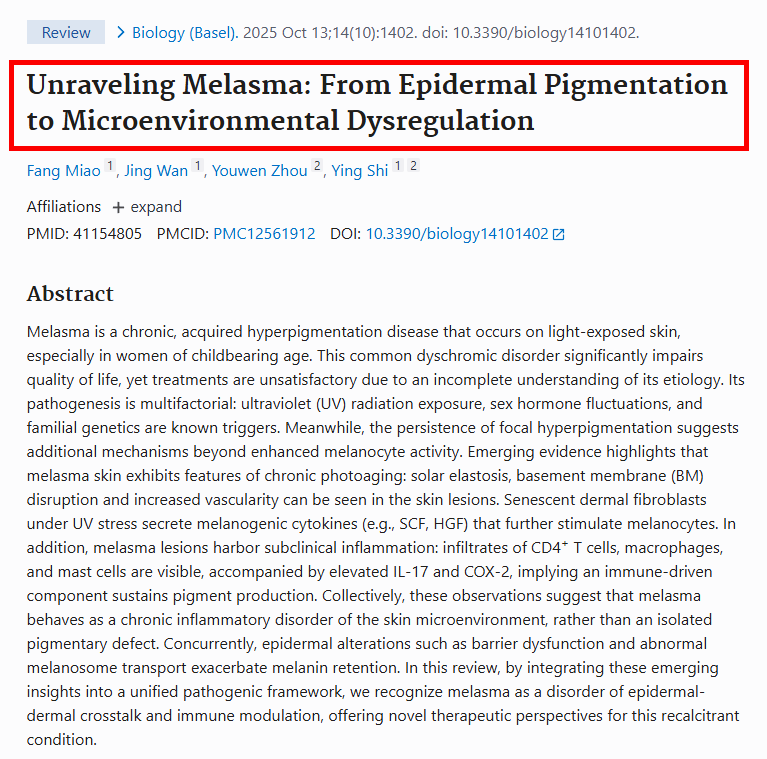
According to research in an international journal, melasma is a multifactorial condition in which ultraviolet exposure, hormonal change and family history act at the same time. When those factors overlap and clinical inflammation develops, pigment production continues in line with the immune response.
That is where the reason lies that melasma treatment does not end with a procedure to remove pigment, but has to include managing the lifestyle factors behind recurrence. It is also why checking medication, experience of pregnancy and childbirth, and sunscreen habits during the consultation is part of the treatment plan.