Yonsei Kim & Lee Dermatology Doctor's Column
Dermatology Column

Juvelook Skin vs Juvelook Volume: What Is the Difference?

How Juvelook Skin and Juvelook Volume differ in the way they work, and why side effects such as nodules occur.

Published 2026-10-27 Updated 2026-10-27 Reviewed by Taehyung Kim, Medical Director · Dermatology Specialist

Juvelook is divided into two types, Skin and Volume, according to particle size and content, and the choice depends not on which treatment is better but on which concern a person wants to improve.

Both products share the same principle of stimulating fibroblasts to induce the body's own collagen production, but the particle size differs by about 1.7 times and the content by about 4 times, so the areas they are applied to differ, and in many cases side effects such as nodules also come from the hydration process and control of the injection depth rather than from the treatment itself.

01

How do Juvelook Skin and Juvelook Volume work?

Key point
Juvelook Skin and Juvelook Volume both work in the same way: the ingredient stimulates fibroblasts so that the body produces its own collagen. However, because the particle size and content differ, the skin layer each is applied to and the purpose of improvement are different from each other.

When Juvelook is injected into the skin, the ingredient stimulates fibroblasts and delivers a signal to produce collagen, and as the fibroblasts generate the body's own collagen, volume fills in naturally from within. This is a different mode of action from the way a filler fills immediately.

What separates Skin from Volume is not which has the superior effect but particle size and content. Compared with Juvelook Skin, Juvelook Volume has particles about 1.7 times larger and contains about 4 times more of the ingredient, so the areas they are applied to are clearly divided.
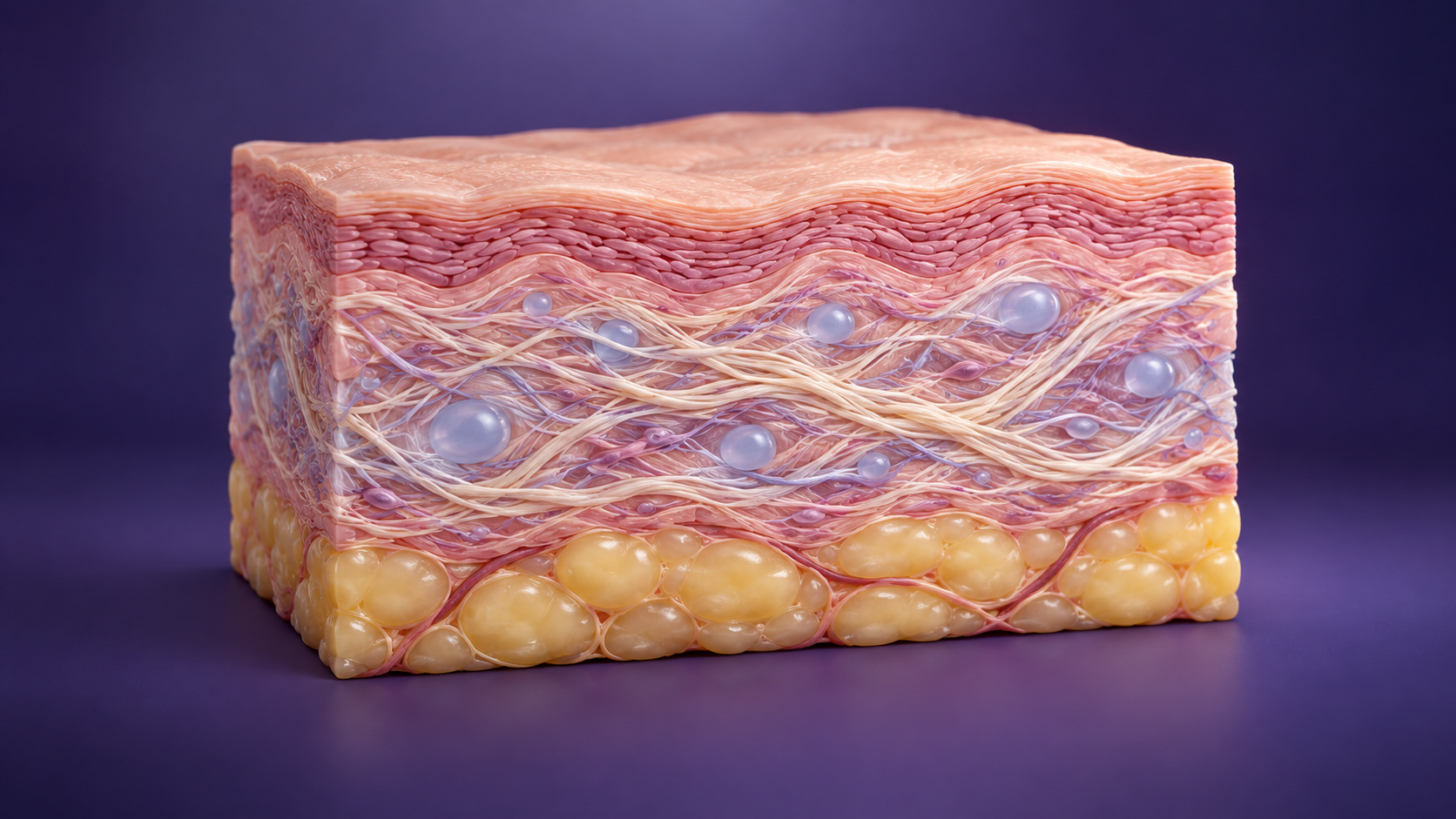
Anatomy illustration related to Juvelook Skin vs Juvelook Volume: What Is the Difference?
02

Which concerns is Juvelook Skin suited to?

Key point
Because its particles are small, Juvelook Skin spreads evenly through a shallow layer and works by firming the skin in a fine, dense way. It is broadly suited to concerns related to the surface texture of the skin, such as pores or fine lines.

Compared with Volume, Juvelook Skin has smaller particles and is injected only as far as the shallow dermal layer, and it is the treatment considered first when the surface texture feels rough or firmness feels reduced. This is because the fine particles spread through the shallow layer and tighten the dermal environment densely.

The three changes of smaller pores, softer fine lines and smoother skin texture are results that appear as Juvelook Skin spreads through the shallow dermal layer and remodels a weakened dermal environment, and the treatment can be considered even if only one of these concerns is present.

  • Smaller pores — the particles spread through the shallow dermal layer and tighten widened pores
  • Softer fine lines — the tightened dermis makes fine lines gentler
  • Smoother skin texture — the texture is refined as the weakened dermal environment is remodelled
03

Is Juvelook Volume always a better treatment than Skin?

Key point
Juvelook Volume is not a superior treatment to Juvelook Skin simply because its particles are larger and its content is higher. It is suited to an overall lack of volume, such as hollow cheeks, and if the surface texture of the skin is the concern, Juvelook Skin is the better fit.

Compared with Juvelook Skin, Juvelook Volume has particles about 1.7 times larger and contains about 4 times more of the ingredient, so it is injected as far as the lower dermis, where it supports sunken areas and creates contour through the body's own collagen production.

An overall lack of volume, such as hollow cheeks or nasolabial folds, improves as Juvelook Volume induces the body's own collagen production in the deep dermal layer and fills the area gradually, and unlike a filler, it fills without a foreign-body sensation. If surface texture or pores are the concern, Juvelook Skin is the better fit.

04

Why do nodules form after a Juvelook treatment?

Key point
In many cases, nodules do not come from a limitation of the treatment itself but from the hydration process, in which the powder ingredient is diluted with saline, and from control of the injection depth. How precisely these steps are followed is what determines the result.

Juvelook Skin and Volume both start as a powder formulation and must go through a hydration process in which the powder is diluted with physiological saline at a set ratio. If the powder does not dissolve evenly and clumps together, the clumps are injected as they are and remain as nodules.

Even when the dilution has been completed perfectly, the injection depth and spacing must be controlled with care. Because the thickness of the dermal layer differs slightly from person to person, the position also has to be adjusted while feeling the resistance of the skin through the fingertips. This is why set figures alone are not followed.

  • Following the hydration guide precisely — diluting the powder while keeping to the ratio and time
  • Controlling injection depth and spacing — keeping to the dermal depth that suits Skin or Volume
  • Checking skin resistance by fingertip feel — adjusting the position to the thickness of the dermal layer
Taehyung Kim, Medical Director
Doctor's view

How the doctor decides

Taehyung Kim, Medical Director · Dermatology Specialist

I look at particle size and purpose first

When I recommend Juvelook, I do not say that either Skin or Volume is the better one. I first distinguish whether the concern is surface texture, pores or fine lines, or an overall lack of volume such as hollow cheeks, and then I decide on the treatment. That is how I can accurately choose the treatment that matches the change the patient wants.

I check the hydration process myself

I check with my own eyes whether the powder ingredient has been dissolved evenly, strictly keeping to the ratio and time for diluting it with physiological saline. Because clumped powder that remains can lead to nodules, I do not skip this step.

I adjust the depth by fingertip feel

Because the thickness of the dermal layer differs from person to person, I do not mechanically follow a set depth alone; I feel the resistance of the skin through my fingertips and adjust the injection position moment by moment. That is how the result settles in naturally.

I do not promise an immediate effect

Juvelook is not a treatment that fills volume immediately like a filler; it works by inducing the body's own collagen production. So in the consultation before the treatment, I explain this difference first, and we agree together on the pace of change the patient wants.

Summary

In summary

Juvelook Skin and Volume work on the same principle, but the concerns they can improve differ because of the difference in particle size and content. Considering Skin first when surface texture is the concern, and Volume first when a lack of volume is the concern, fits the purpose. Because nodules in many cases come from the hydration process and control of the injection depth, it is better to check this in a consultation before deciding.

FAQ

Frequently asked questions

QHow much do Juvelook Skin and Volume differ in particle size?
A

Compared with Juvelook Skin, Juvelook Volume has particles about 1.7 times larger and contains about 4 times more of the ingredient. Larger and more is not necessarily better, and the choice depends on the purpose.

QDoes Juvelook show an effect straight away like a filler?
A

It does not fill immediately like a filler; it works by stimulating fibroblasts to induce the body's own collagen production. That is why volume fills in naturally from within, without a foreign-body sensation.

QWhy do nodules form after a Juvelook treatment?
A

During the hydration process, in which the powder ingredient is diluted with saline, clumps form if the powder does not dissolve evenly and sticks together. If these clumps are injected as they are, they can remain as nodules.

Taehyung Kim, Medical Director
Medical review
Taehyung Kim, Medical Director · Dermatology Specialist
This content is general medical information and may not apply to every individual. Diagnosis and treatment are decided through a consultation.