If a toenail takes on a pale yellow tinge, its surface becomes rough and breaks easily, and it even gives off an odour, it is worth suspecting nail fungus. Nail fungus is a condition that appears when a fungus called a dermatophyte infects the toenail and the surrounding horny layer of the skin, and it spreads particularly easily in hot, humid environments such as the inside of shoes.
To give the conclusion first, nail fungus is easy to leave alone because it causes no pain, but it is a chronic infection that, as time passes, leads to toenail deformity and pain when walking. Treatment is divided into drug treatment centred on oral medication and ointment, and laser treatment, and the methods should be combined according to the patient's health.
Why does nail fungus develop?
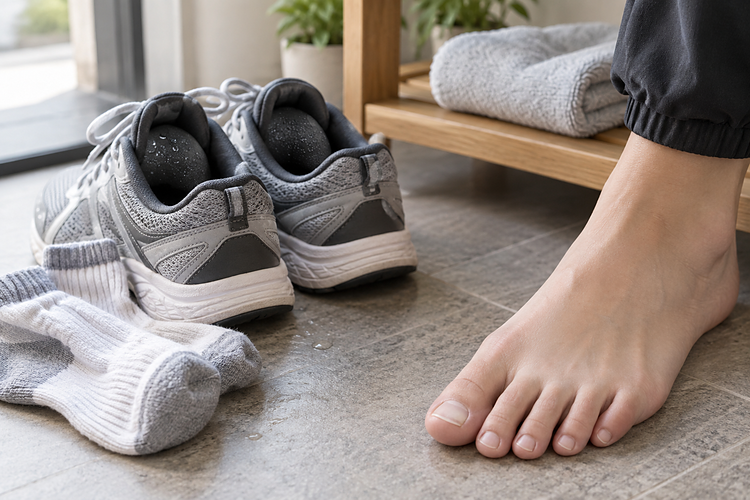
Dermatophytes multiply readily in hot, humid environments such as the inside of shoes, so the longer poorly ventilated shoes are worn, the greater the risk of toenail infection, and barefoot shared spaces such as swimming pools and saunas are also a common route by which the infection spreads.
When immunity drops, resistance to dermatophytes weakens and infection and the progression of symptoms speed up, so people with diabetes or low immunity are safer checking their feet and toenails frequently and seeing a doctor if anything feels abnormal.
- Inside shoes — poorly ventilated dress shoes and trainers create good conditions for the fungus to multiply
- Use of shared spaces — the fungus can spread through barefoot contact in swimming pools or saunas
- Weakened immunity — with diabetes or a weakened immune state, infection and progression are faster
What symptoms could mean nail fungus?
If the toenail darkens to yellow or yellowish-brown and its surface becomes rough and breaks easily, nail fungus is suspected, and if odour, white powder and vertical streaks are also present, the likelihood of infection is higher.
Even if the colour of the toenail does not clearly change, it is hard to rule out nail fungus when only the skin under the toenail peels or cracks, and because pain and itching are mild, many people go on without knowing until it has progressed considerably.
- Toenail discolouration — gradually darkens to yellow or yellowish-brown
- Surface changes — the surface becomes rough and breaks easily
- Odour and powder — there is an odour and a white powder falls off
- Streaks — vertical streaks may also appear on the toenail
What treatment options are there for nail fungus?
Over-the-counter ointments that are easy to obtain at pharmacies are not classified as medicines, so in many cases it is hard to expect them to be effective enough to root out the fungus, and not a few people give up on treatment because no real change appears in the toenail even after applying them steadily for a long time.
Some effect can be expected only when prescribed oral medication and ointment are used together, but because oral medication is strong, its use is often restricted for pregnant women, people with liver disease and those with other chronic conditions, so some people are left unsure, unable even to start drug treatment.
- Oral medication — suppresses the fungus with ingredients such as terbinafine, itraconazole and fluconazole
- Ointment — an effect can be expected only when a prescribed topical treatment is used together with oral medication
- Laser treatment — used as an alternative for patients whose use of medication is restricted
How often is laser treatment needed?
The Onyco laser works by using two wavelengths to destroy the cell membrane of the fungus and activate immune cells, and because it is a non-thermal treatment that does not use heat, there is almost no pain during the procedure; another advantage cited is that both hands and both feet can be treated at once.
The number of sessions is adjusted to the degree of progression and how the toenail recovers, so it differs from patient to patient, but treatment usually proceeds at 2-week intervals for about 15 sessions, and because the fungus is destroyed starting from the cell membrane, some patients feel the effect from early on.
- Wavelengths — 635 nanometres and 405 nanometres are used together
- Treatment cycle — usually about 15 sessions at 2-week intervals
- Non — thermal method — no heat is used, so there is almost no pain during the procedure