Yonsei Kim & Lee Dermatology Doctor's Column
Dermatology Column

RF Lifting Devices: Is a Newer Generation Always Better?

How radiofrequency and ultrasound lifting devices differ in principle by generation, and how to choose according to skin condition.

Published 2026-10-20 Updated 2026-10-20 Reviewed by Taehyung Kim, Medical Director · Dermatology Specialist

New radiofrequency (RF) lifting devices are released every year, and their similar names often cause confusion. This column looks at how the RF lifting devices widely used in Korea have developed from one generation to the next, and at the fact that a higher generation does not automatically lead to a better result. To give the conclusion first, what shapes the effect is not the generation of the device but the diagnosis and the distribution of energy matched to the skin condition and the cause of sagging.

1st-generation devices delivered radiofrequency energy to the dermis to encourage collagen synthesis and were used to improve fine lines and firmness; over later generations, the way heat is delivered and the depth the energy reaches became more finely divided. In 3 minutes, a reader can understand how the principles differ by generation and the criteria for judging which combination suits them.

01

How does 1st-generation radiofrequency lifting work?

Key point
1st-generation radiofrequency lifting delivers radiofrequency energy into the dermis to encourage collagen synthesis. In doing so, it smooths fine lines and fills out the density of the dermis, which raises the firmness of the skin. The change builds up gradually over time, rather than appearing straight after a treatment session.

1st-generation radiofrequency lifting delivers radiofrequency energy into the dermis to encourage collagen synthesis, and as a result it smooths fine lines while filling out dermal density to lift skin firmness. It is a type of lifting device that has been widely used in a way suited to the skin characteristics of Korean patients.

The radiofrequency energy is delivered inside the dermal layer rather than to the skin surface, where it generates heat. This heat stimulus activates fibroblasts and encourages new collagen to be synthesised. It is classed as a treatment in which firmness improves gradually over several weeks to several months, rather than one that brings an immediate change.
Anatomy illustration related to RF Lifting Devices: Is a Newer Generation Always Better?
02

How does heat delivery change as the generation goes up?

Key point
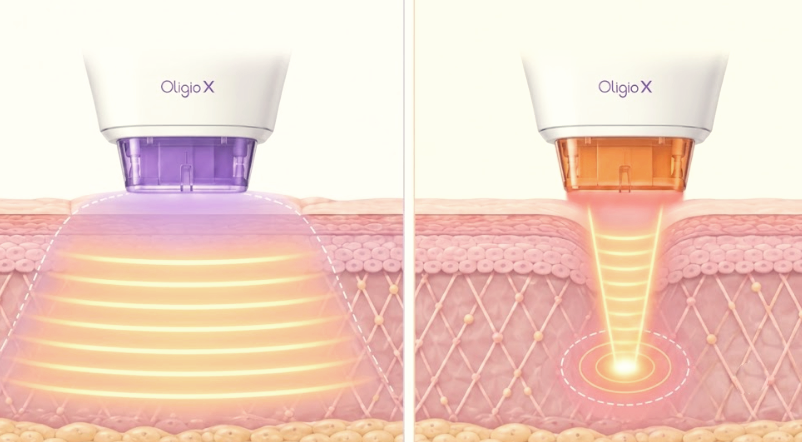
Next-generation devices deliver heat more gently and slowly, and their cooling function has been strengthened. Their functions are also divided into two modes: one mode that works on the upper dermis, and another mode that delivers energy further down, as far as the lower dermis, while the surface stays protected.

Two things changed in the next-generation devices: heat is delivered more gently and slowly, and the cooling function is stronger. Thanks to these changes, the sensation of heat and the discomfort felt during treatment are known to be lower than before in many cases.

These devices are divided into two modes according to the depth the energy reaches: a mode that gently warms the upper dermis and encourages collagen regeneration, and a mode that presses the energy down to the deeper, lower dermis. Because of the stronger cooling, the surface temperature is protected while firmness in the deeper layer is addressed as well.

  • G mode — delivers energy gently to the upper dermis, a mode suited to thin skin and fine lines
  • X mode — presses energy down to the lower dermis while stronger cooling protects the surface
  • Stronger cooling — heat delivery became gentler and cooling became stronger, which lowers the discomfort of treatment
03

Which device is needed to improve sagging contours as well?

Key point
Sagging contours often stem from the fascial layer, which lies below the dermis, so radiofrequency alone has limits in improving them. To make up for this, 3rd-generation devices appeared that add high-intensity focused ultrasound (HIFU) to radiofrequency, allowing sagging and firmness to be addressed together within one device.

The face has areas where the skin is thin, such as around the eyes and mouth, and areas with more facial fat, so the cause of sagging contours is often hard to explain by the dermal layer alone. In practice, the problem is known to arise more often in the fascial layer, which lies deeper than the dermis.

Warming the upper dermis with radiofrequency has limits when it comes to lifting the fascia, so devices appeared that add high-intensity focused ultrasound (HIFU) energy to conventional radiofrequency (RF), making it possible to address sagging and firmness concerns within one device. Even so, what separates the results is not the generation of the device but a diagnosis that examines skin thickness and the amount of fat.

  • Upper dermis — the layer that radiofrequency energy reaches, improving fine lines and the firmness of thin skin
  • Fascial layer — the layer that focused ultrasound energy reaches, where it acts to pull sagging skin upward
  • Skin thickness — in thick skin the energy settles deeper, so the intensity of focus and of cooling must be adjusted together

Taehyung Kim, Medical Director
Doctor's view

How the doctor decides

Taehyung Kim, Medical Director · Dermatology Specialist

I look at the diagnosis before the device name

I have been practising as a board-certified dermatologist for 11 years, and when I receive an enquiry, I first check whether the skin is on the thin side, whether firmness has dropped and whether the contour has broken down, before thinking about which device to use. Even when the sagging looks the same, a different cause calls for a different type and proportion of energy.

I do not automatically recommend a higher generation

For someone who only needs firmness improved, I do not go out of my way to recommend a 3rd-generation device that includes ultrasound. I judge that energy that is not needed may only add to the burden of the treatment.

I adjust cooling and shot count to skin thickness

For patients with thick skin, the energy settles deeper, so I raise the intensity of focus while adjusting the cooling strength alongside it to protect the temperature of the epidermis. In areas with little fat, I judge carefully whether to use ultrasound at all.

I design the energy combination differently for each area

I design a different combination for each area, raising the proportion of radiofrequency where firmness has dropped and moderating ultrasound where there is little fat. I do not apply one method in the same way across the whole face.

Summary

In summary

Radiofrequency lifting started from the 1st-generation method, went on to divide the areas where heat is delivered more finely, and then developed in the direction of adding focused ultrasound energy. A higher generation does not ensure a better result for everyone, and the energy that is needed differs according to skin thickness and the cause of sagging. If fine lines or reduced firmness are the concern, improvement can be expected from an approach that works on the dermis alone; if the contour has broken down and sagging is marked, an approach that reaches the fascial layer can be considered alongside it. It is better to confirm the energy combination that fits through an accurate diagnosis before receiving treatment.

FAQ

Frequently asked questions

QHow are Oligio and Oligio X different?
A

Oligio X is a device that delivers heat more gently and slowly and has a stronger cooling function, and its functions are divided into a mode that works on the upper dermis and a mode that delivers energy down to the lower dermis. It is applied differently according to skin thickness and the goal.

QWhat technology was added in 3rd-generation devices?
A

3rd-generation devices add high-intensity focused ultrasound (HIFU) energy to conventional radiofrequency (RF), so that energy can be delivered as far as the fascial layer below the dermis. This allows sagging and reduced firmness to be addressed together.

QDoes a higher-generation device always work better?
A

No. The energy that is needed differs according to the skin condition and the cause of sagging, so choosing a higher-generation device without a diagnosis does not always lead to a better result.

Taehyung Kim, Medical Director
Medical review
Taehyung Kim, Medical Director · Dermatology Specialist
This content is general medical information and may not apply to every individual. Diagnosis and treatment are decided through a consultation.